 Austria
 Belgium
 Czech Republic
 Denmark
 Finland
 France
 Germany
 Greece
 Ireland
 Italy
 Latvia
 Luxembourg
 Netherlands
 Norway
 Poland
 Portugal
 Slovakia
 Slovenia
 Spain
 Sweden
 United Kingdom

The Pixtury guide to arranging pictures on your walls
Arranging pictures on your walls is a delicate business. You need to think carefully about how many pictures or prints to hang, their size, how they line up with each other and with the rest of your furniture, how much empty wall space to leave, and which styles and subjects to choose.

One large picture or several small ones? Hung high or low? Colour or black and white? And which subjects should you choose? These are the questions we so often ask ourselves when we set about decorating the walls of our home.
In this short guide, we'll give you a few tips on arranging these pieces with the right touch, and show you some specific rules that will help you create exactly the atmosphere you're after, whether you want to make your home unique, give your office walls an original look or perfect the interior design of your hotel.
You'll also find plenty of example images to suit different needs, which you can buy directly, in just a few clicks, as modern wall art.
1. The aesthetic composition of your home
You finally have the home of your dreams: the flooring you always wanted, your favourite colours on the walls, the curtains, the furniture and every other piece you chose so carefully, right down to the high-end appliances. And yet you still feel your home is missing something that would make it truly unique and special. But what?
The best way to put the finishing touch to your interiors is to decorate the walls with pictures, posters, photographs or art prints – pieces with enormous visual impact that play a major part in shaping the atmosphere of a room.

Pictures, prints and posters live within a wider aesthetic composition that includes your sofas, furniture and every other decorative object in the house. So it's important to keep all these elements in harmony and to arrange them with the overall picture always in mind: the colours, styles, materials and sizes of the different pieces should come together naturally.


2. Focal points, colours and styles
Every object in a room acts as a "focal point", a spot that draws the viewer's eye. When arranging pictures, the aim is to keep a balance between the various elements so as not to create a sense of visual clutter. This principle matters especially in decorating styles built on balance and simplicity, such as Nordic interiors inspired by Scandinavian design.
Larger objects make the strongest focal points, and everything else should be planned to revolve around them. As a general rule, it's best to avoid both too much and too little visual stimulation, finding the right balance for each room.
Two other things to consider for a harmonious composition are the colours and the style of your prints, which should blend naturally with those of the rest of your décor.
If your room feels too bland or static, you can be bold and use prints in the opposite way, creating a lively contrast.
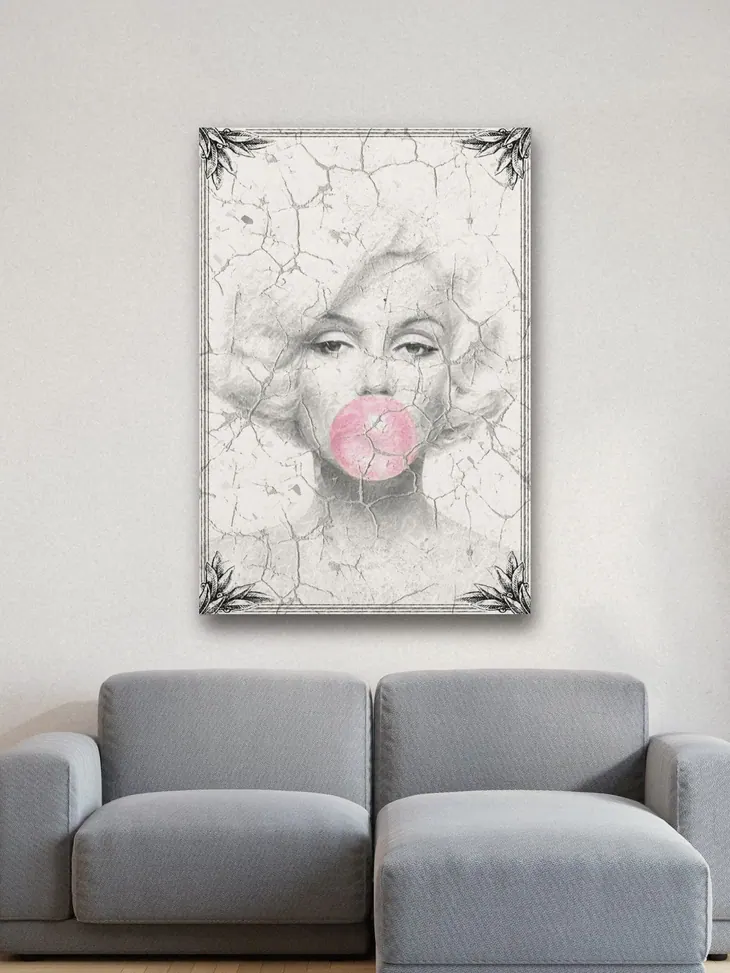
Here's an example: a print like this one, with its modern lines, could work beautifully in a Provençal-style interior, in a Shabby Chic home or to create the perfect Art Nouveau look.

And here's another example: a classic print that can create an interesting contrast in a modern home or in an urban-style home.

3. Arranging pictures on your walls
Now let's look at some more specific rules for arranging pictures on your walls.
3.1 How high to hang your pictures
A picture should always be positioned so that it's clearly visible to the viewer. As a general rule, pictures should be hung at 5/8 of the wall's height (so on a 3-metre wall, the centre of the picture should sit at 1.85 metres). Of course, you also need to consider the type of picture and the size of the room, which will determine how far away the viewer stands.
Large pictures, with little detail and dark tones, like this purple "Carnevale" (and landscape prints in general), should be hung high, as they are meant to be taken in as a whole at a single glance.

Conversely, smaller pictures that are rich in detail and in light tones, like the ones below, are best hung lower so they can be seen properly (as is the case, for example, with flower pictures and prints).


3.2 Hanging lots of pictures
To hang several prints on the same wall, there are a few rules to bear in mind if you want to avoid a messy effect.
If you have a large print or one with strong impact, like the stunning landscapes below, give it the visibility it deserves by placing it on a large surface (even an entire wall), or by leaving some empty space around it so that the viewer's attention is drawn straight to it.


For a row of pictures to be pleasing to the eye, it needs to be aligned.
You can line the pieces up along their bottom edges, their top edges or their centre line. A particularly elegant effect comes from aligning the prints with another piece of furniture or architectural feature too: the top of a door frame, the end of a shelf or the edge of a sofa. Either way, if the pictures are different sizes, the largest should go at either end of the row, and the spacing between them should be even. In the same way, these rules also apply to vertical arrangements.
A cluster of pictures needs a certain geometric harmony: the outer edges should line up along the perimeter of a square or rectangle enclosing the whole arrangement, the spacing between the pictures should be even, and there should be an overall harmony of style and colour. If the pictures are different sizes, place the largest in the centre and arrange the smaller ones around the edges.
3.3 Arranging pictures on narrow walls
For narrow walls, such as those in a hallway, between two windows or next to a door, you can use portrait-format prints to fill the space while keeping a geometric harmony with the surroundings.
Here are a few examples of portrait prints with slender, harmonious images:


4. Practical tips for decorating your walls
Finally, a few tips to help you get your wall decoration just right:
- Before you start putting nails or hooks into the wall, stand the picture on the floor below the spot where you plan to hang it. This will give you an immediate first impression of how it works with the other furniture in the room.
- Avoid mixing paintings and photographs.
- With portraits or images of people, the faces in the different pictures should turn towards one another to create a sense of harmony between the various lines of sight. Here's an example below.


Lighting should come from above, not from the side; side lighting makes a print more prone to reflections and shows up its imperfections.
To sum up, always remember that the value of an art print also lies in its uniqueness, its originality and, above all, the emotion it brings once it becomes part of your home.


If you found this article useful, share it with your friends. You can turn every image in this article into wall art and art prints straight from our gallery, where you can buy them in a huge range of sizes in just a few clicks!
And if you still have any questions, get in touch and we'll get back to you as soon as possible!